Client
Pembrokeshire County Council
Value
£105,000
Sectors & Services
Highway Structures Coatings Anchors/Remedial Ties Structural Strengthening Grouting & Injection Projects Projects
The Cleddau Bridge, originally known as the Milford Haven Bridge, carries the A477 over the River Cleddau between Neyland and Pembroke Dock in South Wales. The 800 m long crossing is a vital strategic link, with its five river-founded piers supporting traffic that would otherwise face significant diversion routes if restrictions were imposed.
Structural assessment identified the need for strengthening works to the pier heads to maintain load capacity and ensure continued safe operation. Timely intervention was therefore critical to avoid major traffic disruption and protect this key transport asset. CRL was appointed to deliver specialist strengthening works in a highly constrained and exposed environment.
Services undertaken
-
Installation of mobile underslung bridge gantry for access
-
Detailed survey works to identify delamination and anchor locations
-
Substrate testing using hydra-jaws pull-off meter
-
Design implementation of CFRP strengthening system
-
Installation of Sikawrap CFRP wrap in multiple layers
-
Application of epoxy resin bonding system and protective Sika coating to CFRP
-
Installation, stressing and grouting of CFRP anchors


CRL delivered a technically demanding strengthening scheme focused on the pier heads and bents of the Cleddau Bridge. Access to the structure was a major constraint, with the only viable means of reaching the pier heads being a mobile underslung bridge gantry that travelled along the full length of the 800 m bridge. This gantry provided access to scaffolding erected around each pier head, allowing works to proceed safely above the river environment.
Once access was established, preparation works were carried out using high-pressure water jetting to clean the concrete surfaces and remove contaminants. Detailed survey works followed to identify any areas of delamination and to agree the precise locations for coring to accommodate the strengthening anchors. Substrate quality was verified using a hydra-jaws pull-off meter, ensuring suitability for the application of bonded strengthening systems. Minor defects were made good using epoxy mortar prior to strengthening installation.
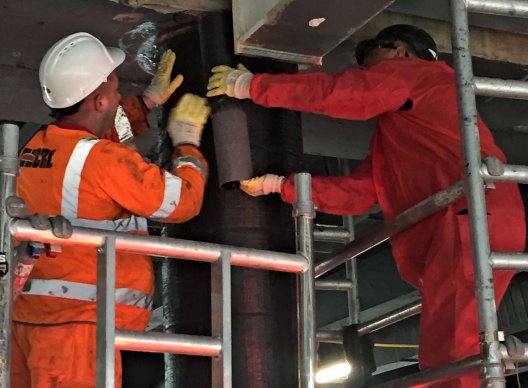
The strengthening solution comprised a carbon fibre reinforced polymer system designed for CRL by Tony Gee Associates. Sikawrap CFRP was applied around the pier heads in three discrete 600 mm wide bands. The number of layers applied varied between four and twelve, depending on pier height and structural demand. The CFRP was installed by roller into Sikadur epoxy resin, with environmental conditions closely monitored throughout due to the exposed bridge location and persistent high winds.
Following completion of the wrap installation, the CFRP system was coated with a Sika protective coating to prevent ultraviolet degradation. Holes were then cored through the pier heads, with wastewater controlled via the scaffold protection system. CFRP anchors were installed into the cored holes, stressed to design load and grouted to complete the strengthening system. In addition, CRL installed a new portacabin to support future bridge maintenance activities, demonstrating a holistic approach to structural repairs UK and long-term asset management.

"The strengthening works carried out on the bridge were truly innovative and this was recognised by the project being awarded an ICE Award"
Steve Jones | Southern Regional Director | CRL
The use of CFRP wrapping and anchored strengthening provides a durable, low-intrusion solution that enhances load capacity without significantly increasing dead weight on the river-founded piers. Thorough surface preparation by water jetting and substrate testing ensured optimal bond performance of the Sikawrap system, while epoxy mortar repairs addressed local defects prior to strengthening.
Protective coating of the installed CFRP safeguards the system against ultraviolet exposure, ensuring long-term performance in a harsh marine and wind-exposed environment. Anchored CFRP elements, fully grouted into the pier heads, deliver reliable load transfer and redundancy. Collectively, these measures reduce the need for future intervention, enhance structural resilience and extend the service life of the bridge, helping to maintain network reliability and minimise whole-life maintenance costs.